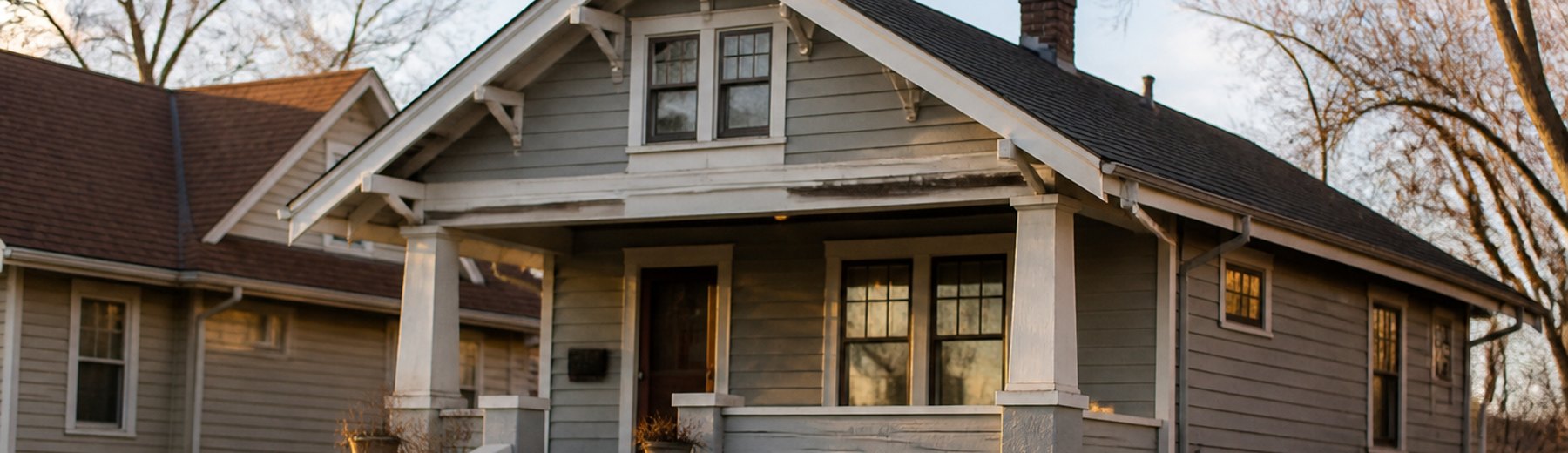
Before Zillow, before the model home, before "build to suit," America ordered houses the way it ordered washing machines: from a catalog. I still love that idea, and I still love the houses that came out of it.
From 1908 to 1940, Sears, Roebuck and Co. sold Sears Modern Homes: precut kit houses shipped by rail. Historians usually put completed homes somewhere around 70,000 to 75,000 nationwide. Many still stand. Some sit in South Carolina neighborhoods where nobody advertising the listing knows they are looking at a catalog house.
I am biased, and I will say so up front. A well-kept Sears Modern Home is one of my favorite kinds of American house: honest proportions, real lumber, a porch that means something, and a story that survived a century of fashion. This History Note is the long version: what you actually bought, how the money worked, how to spot one, what still matters in due diligence, and why kit-home DNA still shows up when buyers ask me about factory housing today.
Why I love Sears houses
I love Sears houses for the same reasons I love a good Lowcountry bungalow that has been cared for instead of flipped into oblivion. The plans were designed for real families, not Instagram. Rooms make sense. Stairs land where you need them. The porch is not a tiny decorative shelf. On Honor Bilt models especially, the lumber quality can still shame some of what ships to jobsites now.
I also love what the program represents. Ordinary people could open a book, pick a house, finance it through the same company that sold the nails, and build a stake in a town that had a railroad. That is not nostalgia for its own sake. It is proof that American housing has always had creative supply chains when someone decided to make homeownership reachable.
When I walk a suspected Sears, I am not hunting for a museum piece. I am looking for a house with bones, character, and a paper trail. If the lore checks out, even better. If it does not, I can still love the house for what it is.
What you actually bought
A Sears Modern Home was not a cardboard cottage. For the listed price you typically got numbered lumber (often milled and marked so each stick matched a page in the instruction book), millwork, hardware, paint, nails, and a thick assembly manual. Foundations, masonry, plaster, and labor were usually local. Some buyers built with neighbors over a season. Others hired a contractor and treated Sears as the lumberyard that arrived on a flatcar.
Sears sold more than one quality tier. Honor Bilt was the premium line: denser framing standards, better millwork, and the houses collectors argue over today. Standard Built and lighter sectional options existed for tighter budgets. Knowing the tier matters when someone is pricing a "Sears" like it is automatically museum-grade oak.
Designs ranged from modest bungalows and cottages to large foursquares, Dutch Colonials, and Tudor-ish plans. Catalog names still circulate among enthusiasts: the Honor, the Crescent, the Vallonia, the Alhambra, the Hathaway, the Magnolia. The Magnolia was the showpiece of the line in the late 1910s, often cited near the top of the price list (roughly five to six thousand dollars in period dollars, before local labor and foundation). Floor plans were published in the annual book the way a builder today publishes elevations on a website.
Here are six of those pages. Different models, different prices, different floor plans: a Colonial mansion, a Mission house, a five-room bungalow, a Craftsman, an English cottage, and a foursquare. This is what a buyer actually ordered from.
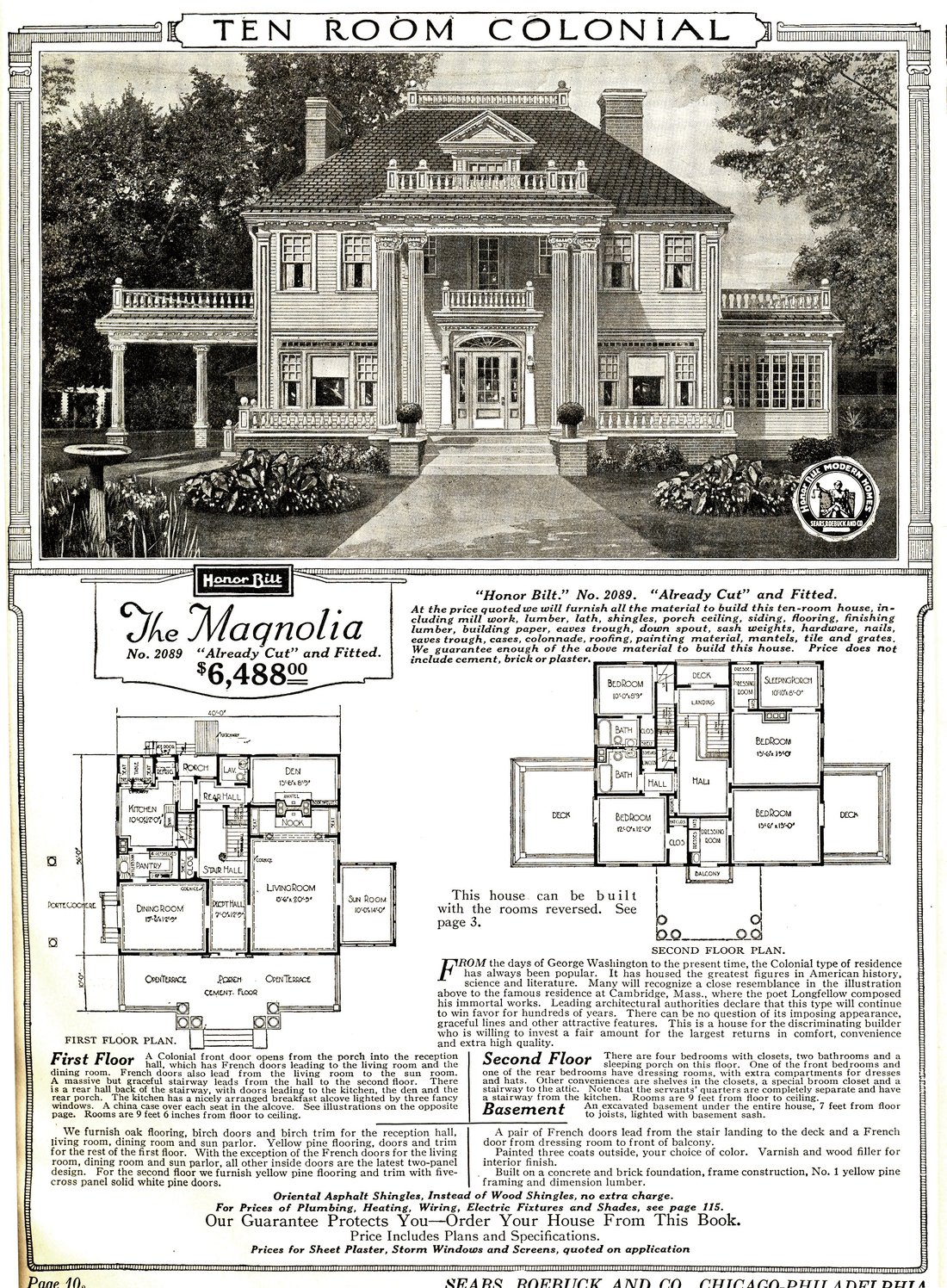
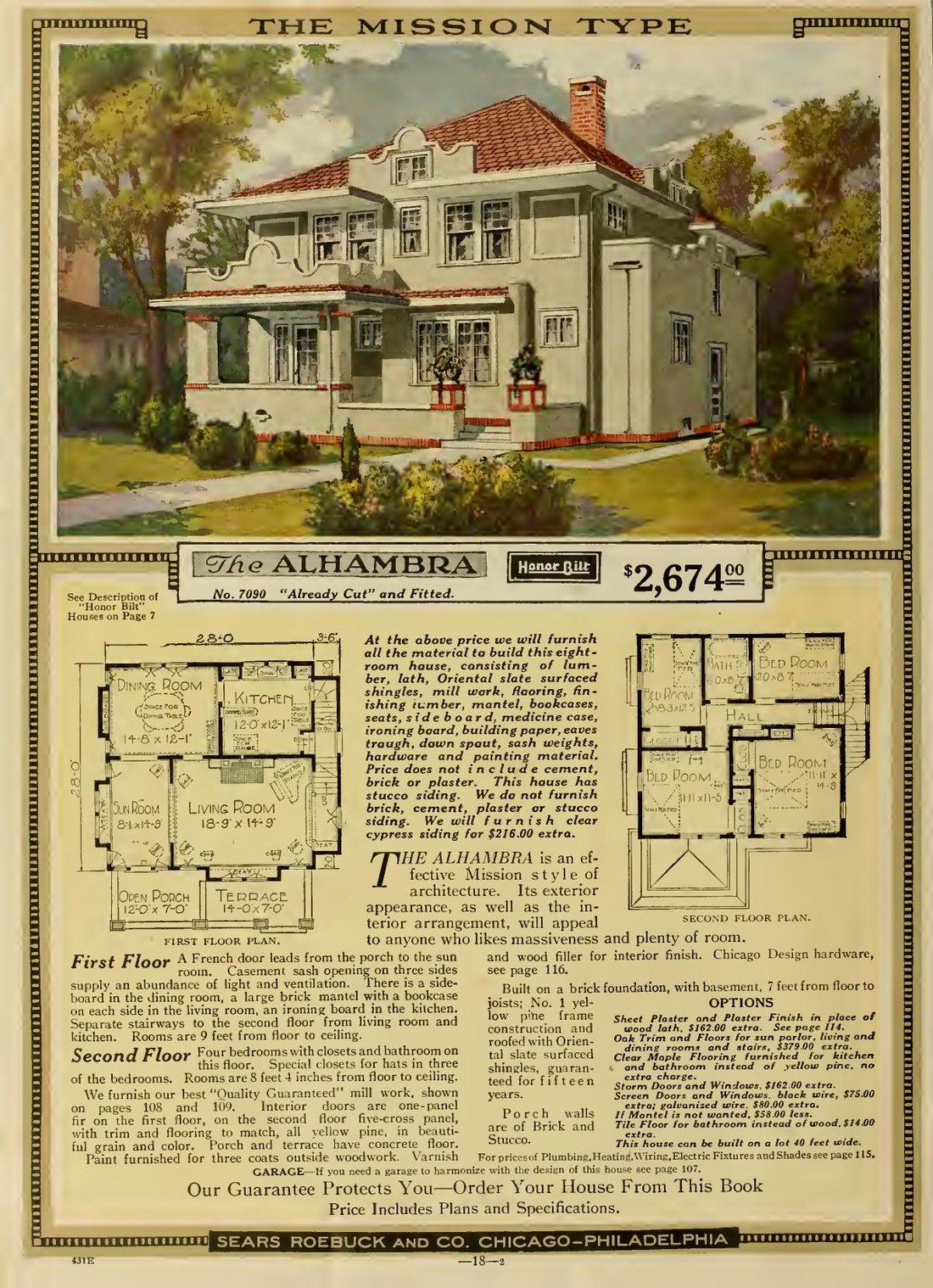
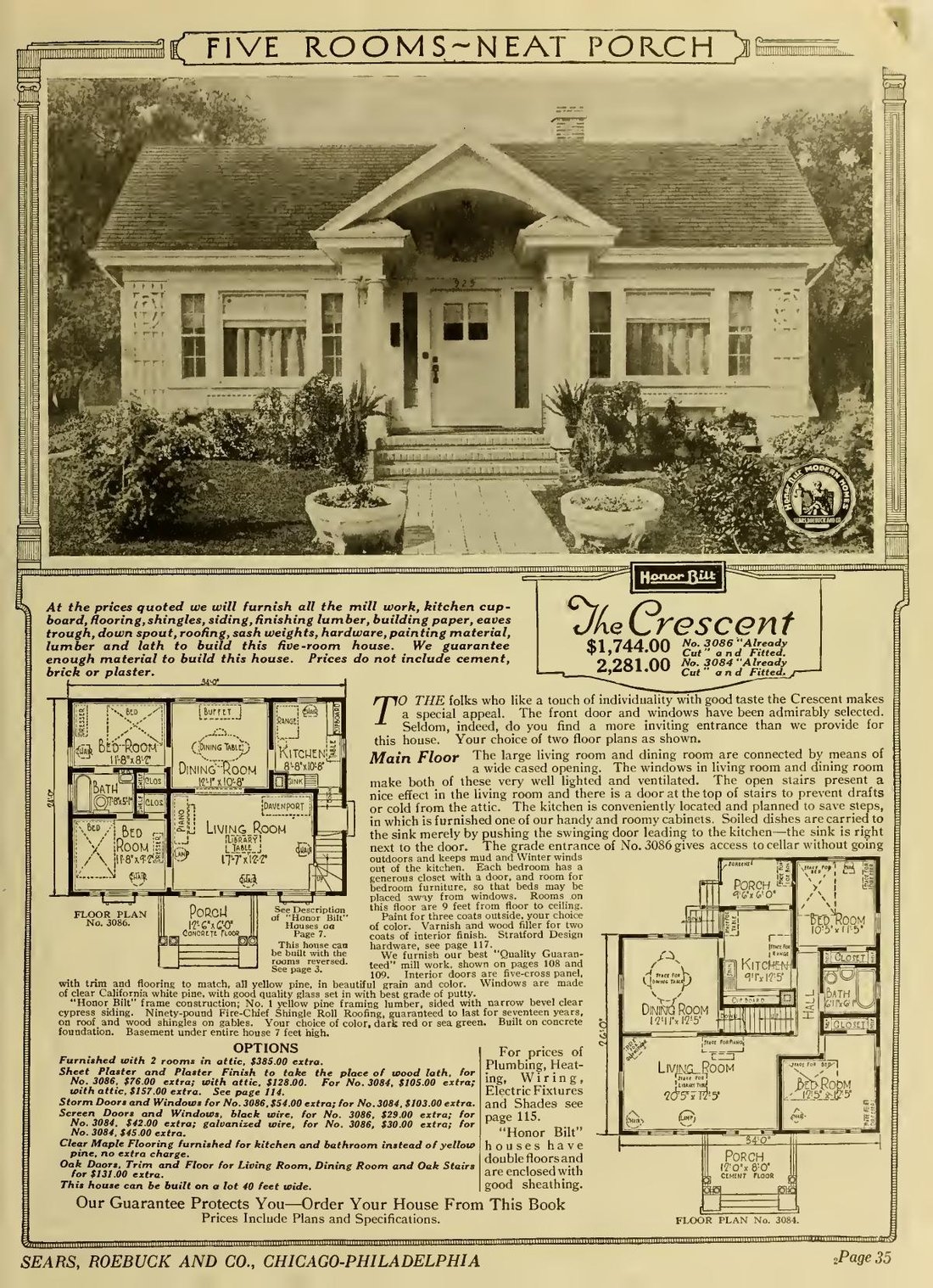
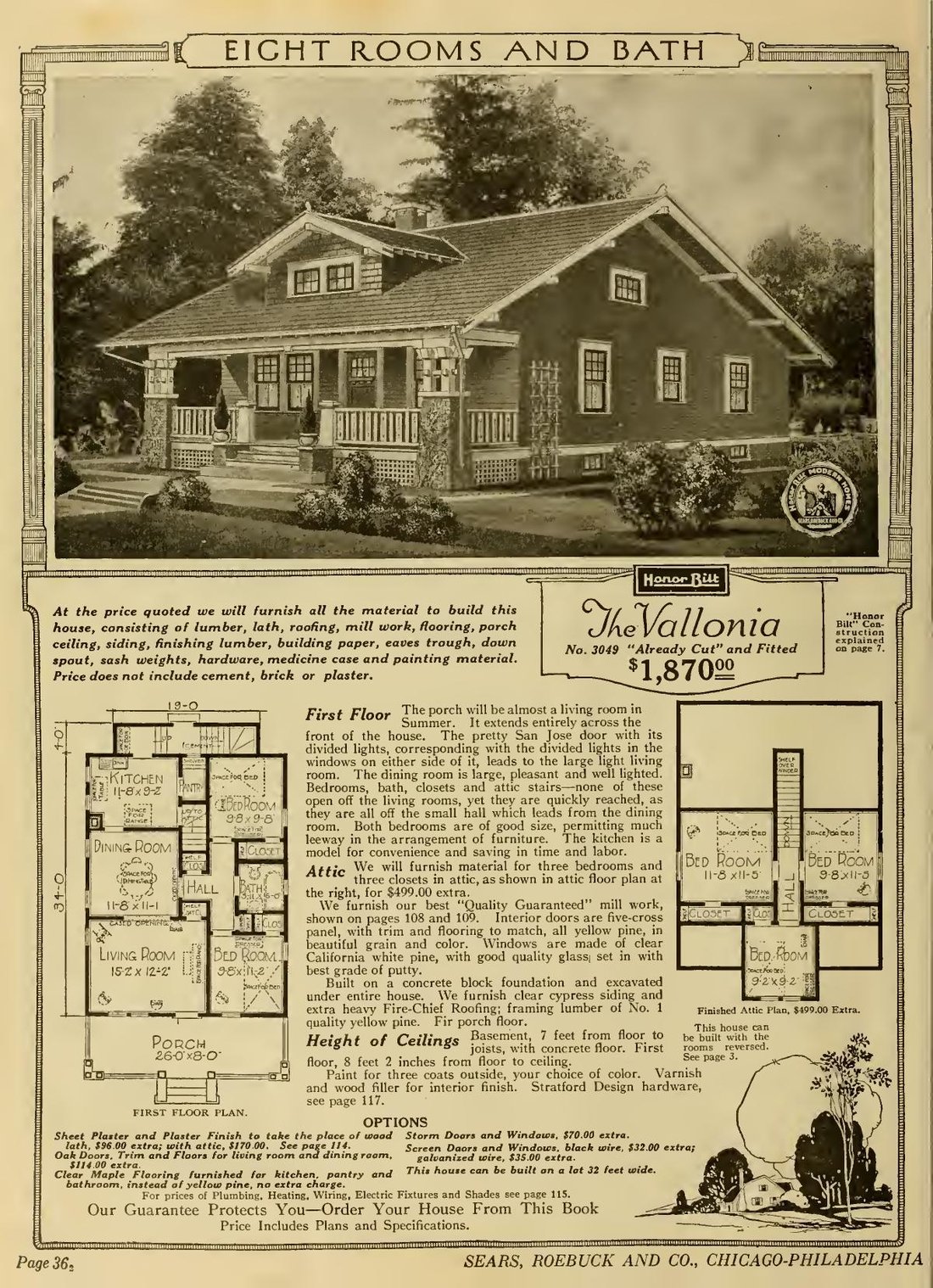
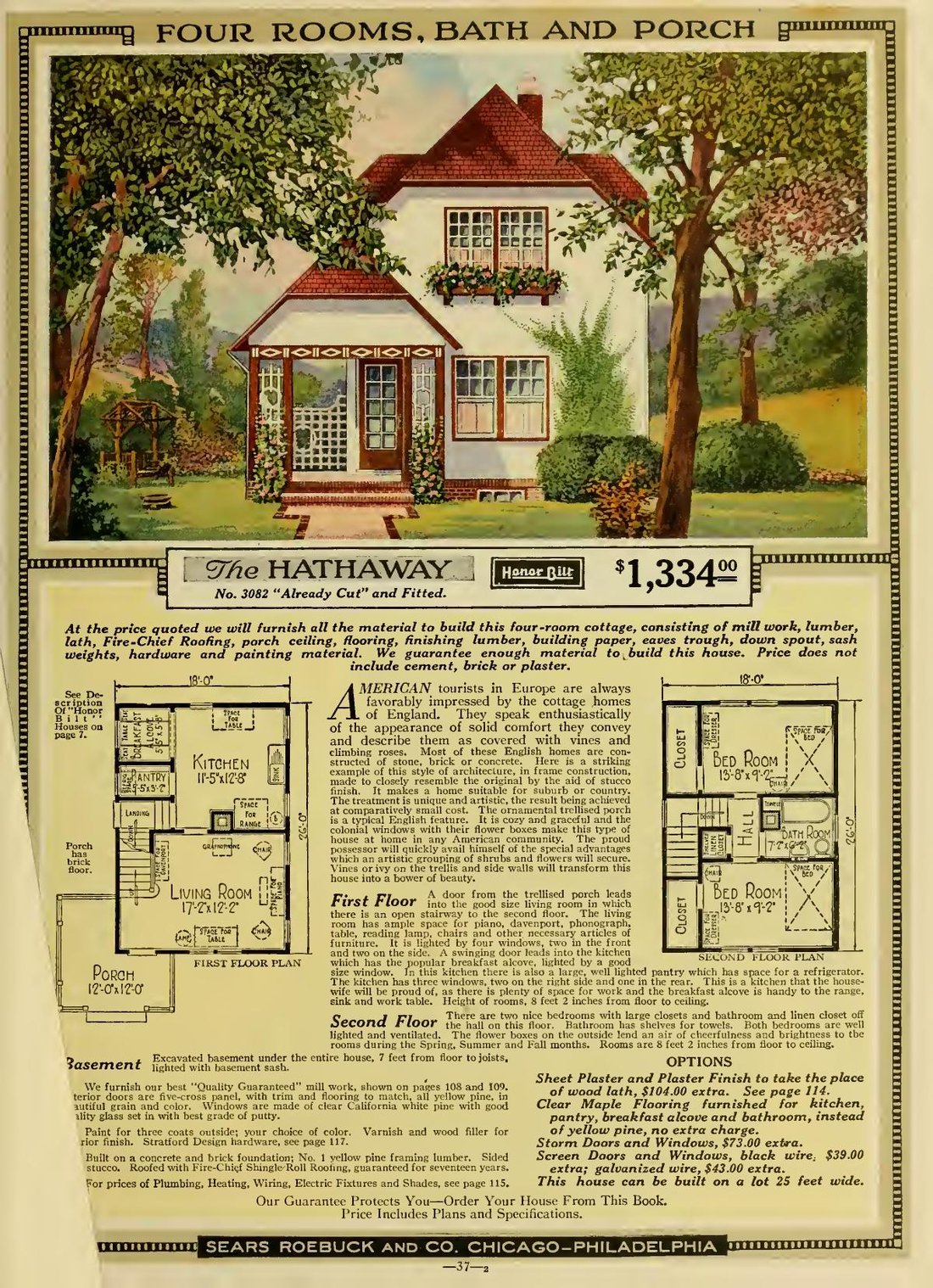
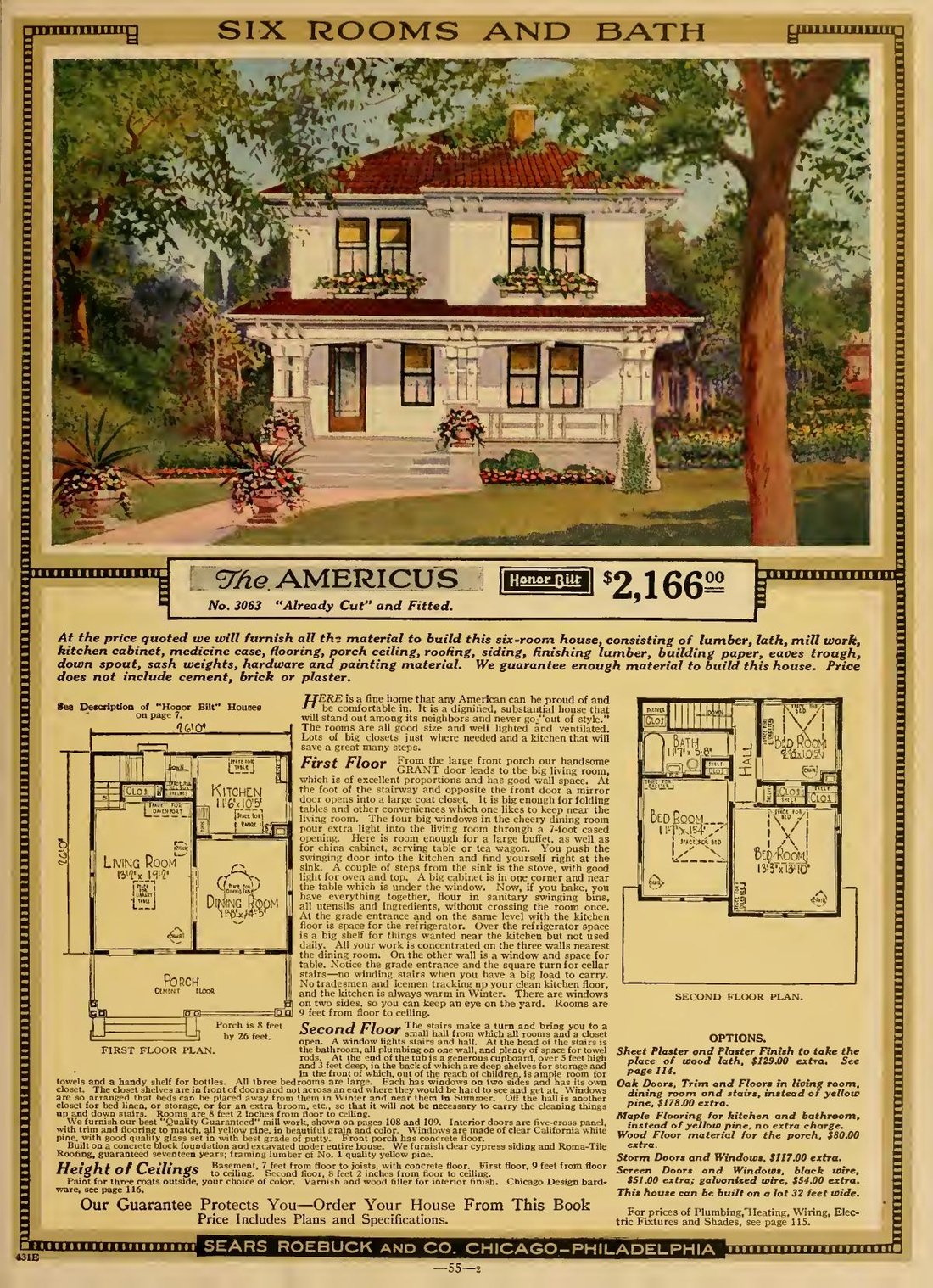
Pages from Sears' 1921 Honor Bilt catalog. Public domain.
Optional extras stacked on fast: storm sash, screen doors, mantelpieces, built-in cabinetry, even plumbing and electrical packages in later years. The kit was a kit. The finished home was whatever the local crew and the buyer's budget made of it.
Think of it as early e-commerce for shelter: standardized parts, national logistics, local assembly. The innovation was the supply chain, not the architecture. And I still think it is one of the smartest housing ideas America ever tried at scale.
Railroads, mills, and the logistics that made it work
Sears could sell a house by mail because America already had a freight network. Kits were packed into one or more boxcars. A modest bungalow might arrive as a few tens of thousands of pieces. Larger plans needed more cars and more patience on the siding.
Lumber and millwork came out of Sears production and contracting relationships that shifted over the decades, including well-known mill and warehouse capacity in places such as Cairo, Illinois, and later facilities tied to the Modern Homes operation. The buyer did not need to understand that map. They needed a town with a depot, a lot, and enough cash or credit to finish the job.
That railroad dependency is one reason kit houses cluster where they do: mill towns, county seats, and early suburbs that grew with the tracks. When a Summerville, Rock Hill, Anderson, or Upstate listing feels "catalog familiar," geography is part of the clue.
The mortgage was part of the pitch
Sears did not only sell kits. For a stretch it financed them. Mortgage programs expanded in the 1910s and into the 1920s, which mattered in an era when credit for ordinary buyers was uneven and local banks were unevenly interested in small houses. The company's willingness to extend loans helped move volume.
Then the Depression arrived. Defaults piled up. Sears tightened, then exited, the home-mortgage business in the early 1930s. The Modern Homes program itself limped toward 1940 and closed. That arc matters for researchers: the paper trail can include old mortgage records, shipping ledgers, and stamped framing members. It also explains why some families have stories of losing a Sears house the same way other families lost any house in the 1930s.
If you research a suspected Sears house today, absence of a stamp does not prove it is not a Sears. Presence of numbered framing often helps. A catalog match plus county records is better than either alone.
Competitors on the same idea
Sears was the most famous name, not the only one. Aladdin Homes (Bay City, Michigan), Montgomery Ward's Wardway Homes, Gordon-Van Tine, and other mail-order and pattern-book companies sold overlapping styles. Local mills copied popular elevations without a national brand on the crate.
That is why I tell buyers not to treat "looks like a Sears" as a closing argument. Plenty of non-Sears houses used similar plans. The point of identification is accuracy, not a party trick. A Gordon-Van Tine or Aladdin with good bones is still a house I can love. A listing that invents a Sears pedigree without evidence is a different problem.
How to spot one without becoming a hobbyist
Agents and buyers do not need a PhD in catalog housing. A practical checklist:
- Age band: roughly 1908 to 1940 construction, especially the 1910s and 1920s boom years.
- Plan familiarity: compare the footprint, porch massing, window rhythm, and roof form to digitized Sears catalogs (libraries, historical societies, and serious collector sites keep scans).
- Framing marks: stamped or penciled numbers on joists and studs in unfinished basements, crawlspaces, or attics. Honor Bilt documentation is the gold standard when you can find it.
- Hardware and millwork clues: period hinges, door hardware, and stair details that match catalog options, treated as supporting evidence, not proof alone.
- Shipping and money trail: local lore, old invoices, newspaper ads naming Sears as the supplier, or mortgage records tied to Sears Roebuck.
- Do not overclaim: similar plans came from Aladdin, Montgomery Ward, Gordon-Van Tine, and local mills. "Catalog era" is sometimes the honest label when the brand cannot be proven.
For a Charleston-area deal, treat "possible kit home" as a research prompt, not a marketing slogan. Confirm with records and a good inspector. I will happily geek out with you on the catalog match. I will not let lore replace diligence.
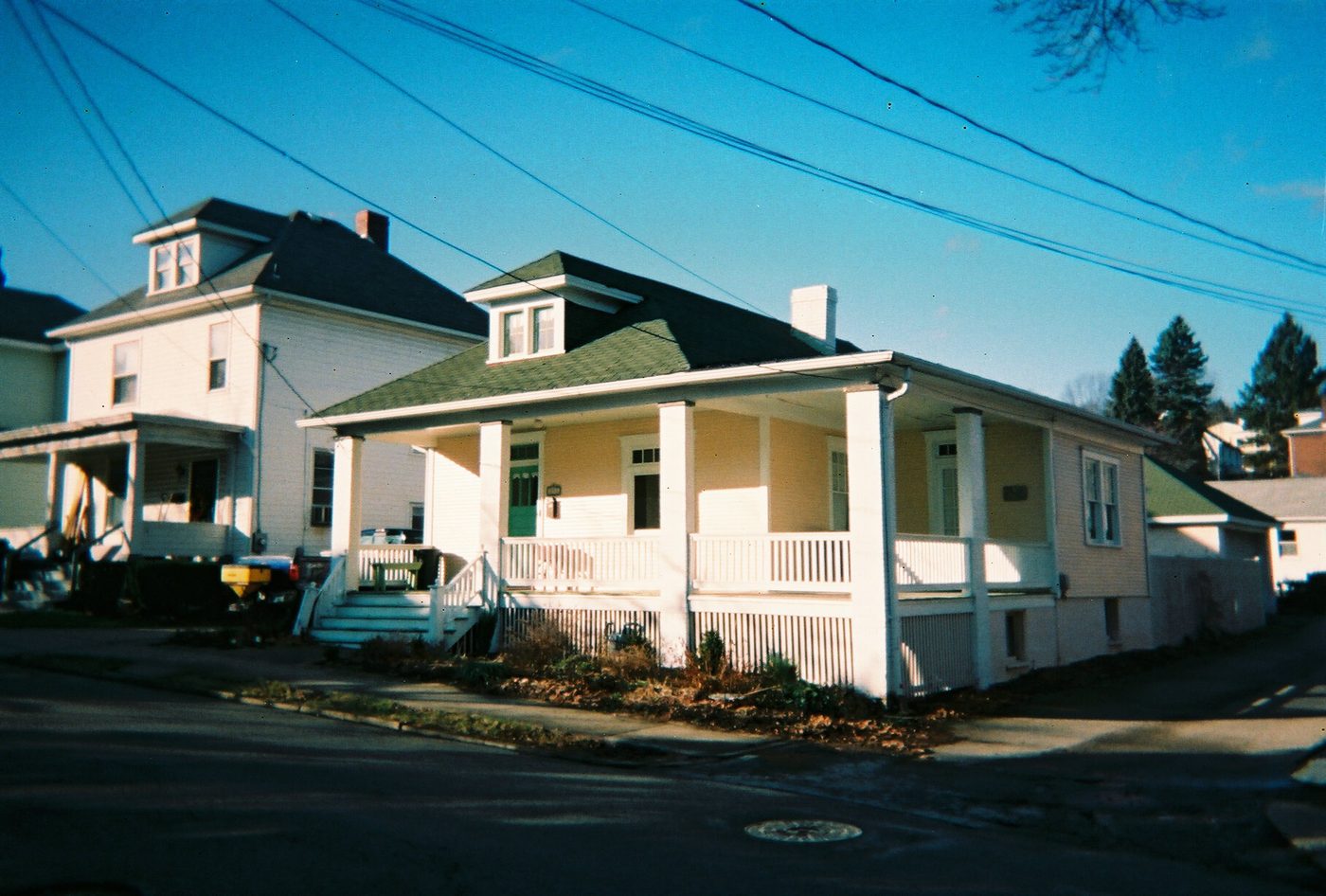
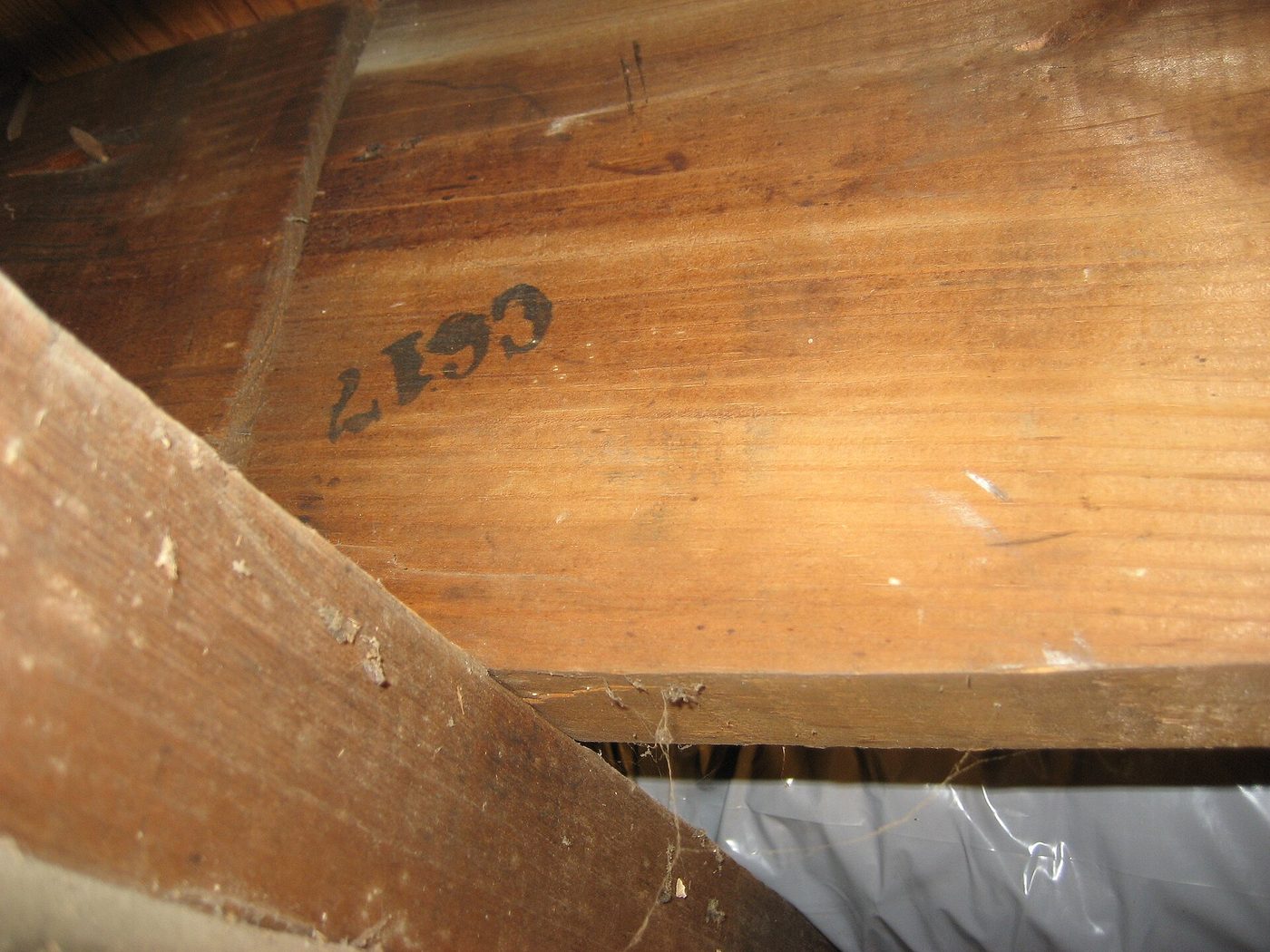
Why a kit home still shows up in due diligence
Older kit houses are ordinary houses with ordinary risks, plus a few patterns worth naming:
- Alterations: porches enclosed, wings added, kitchens opened, baths inserted into former bedrooms. The original catalog plan is a starting point, not a warranty.
- Materials: quality varied by era and price tier. Early Honor Bilt lumber can be excellent old-growth stock. Later and lighter kits were more mixed. Love the house for what is in the walls now, not for a brand name alone.
- Systems: knob-and-tube, early plumbing, galvanized supply lines, and unpermitted updates are about age and ownership history, not brand.
- Settling and additions: a century of porches, sunrooms, and rear ells can hide where the kit ended and the improvisation began. Ask your inspector to read the seams.
- Identity premium: documented Sears houses can attract enthusiasts and a small story premium. Undocumented ones should be priced as the house they are on the lot today.
If the listing leans hard on "historic Sears" without paperwork, ask for the evidence. Story is not a substitute for a survey, a permit pull, and an inspection. I can be romantic about Sears and ruthless about disclosures at the same time. That is the job.
From Sears kits to today's factory homes
Buyers who ask me about manufactured and modular housing in South Carolina are usually surprised that America has been industrializing the house for more than a century. Sears was not HUD-code. It was stick-built from a kit. But the through-line is real: factory cutting, standardized plans, finance wrapped into the offer, and stigma that fades only when the quality on the lot is undeniable.
I wish more of the Sears instinct survived in modern housing: clear plans, honest materials, and a path for ordinary buyers to own something solid without waiting for a custom architect. Factory housing today can be excellent or disappointing. The catalog era is the prequel that proves the idea is older than the stigma.
If you are comparing land-home packages, modular shells, or titled manufactured homes now, start with my guide to mobile and manufactured homes in Charleston and the Land Buildability Score.
The Lowcountry and South Carolina angle
Sears shipped nationwide. South Carolina got its share, especially in mill towns and growing rail-served cities. Charleston's peninsula stock is older and more custom, so you will not find a Sears on every block south of Broad. Kit and pattern-book houses do turn up in early-twentieth-century neighborhoods across the state, and in the rings of towns that grew with the railroad rather than with the tourist postcard.
When a Summerville, Rock Hill, Greenville-Spartanburg, or Midlands listing feels "catalog familiar," it might be. I get a little too excited about that possibility, and I am fine with that. Excitement is allowed. Skipping the records is not.
That does not make a kit home a novelty purchase. It makes it a reminder that American housing has always mixed local labor with national supply chains. The MLS photo just usually forgets to say so.
What I tell clients
I love Sears houses. I will tell you that before we open the crawlspace. Then we do the research: catalog match if it exists, framing marks if accessible, county records, flood and insurance reality, and a thorough inspection. A Sears Modern Home can be a sturdy, charming, ordinary American house with an extraordinary shipping story. Or the listing can be a marketing line. Your job, and mine, is to know which.
If we find a real one, I will enjoy it with you. If we find a beautiful non-Sears bungalow that just happens to look the part, I will enjoy that too. The love is for good houses. The Sears name is the cherry on top when the facts line up.
Keep reading in History: The city Walt Disney never built and The land beneath Charleston.