Most people think EPCOT is the park with the giant golf ball. Walt Disney's original plan was not a theme park. It was a city. I still wish that city would come back.
Walt wanted a functioning community where about 20,000 people would live. Not visit. Not vacation. Live under Disney management. You would not own your home. You would not own your land. You could not retire. Your appliances might get swapped overnight. EPCOT was less happily-ever-after and more life as a beta tester. And even knowing all of that, I look at the Progress City model and feel the ache of a future America almost chose.
I first published this story on Substack at Coastal Life with Jenn. I am expanding it here because Walt's unfinished city still echoes in how America builds master-planned communities, including places Charleston buyers ask about every week. And because I am not done wishing out loud that someone would try the brave parts again, without repeating the controlling ones.
What EPCOT actually stood for
EPCOT meant Experimental Prototype Community of Tomorrow. Not a brand for a permanent World's Fair. A prototype city meant to stay unfinished on purpose: always revising transit, housing, utilities, and corporate research in public view.
Walt framed it as a working American community that corporations and residents would keep updating. Progress was not a slogan on a ride. It was the operating system. That is the part I miss when I walk through today's amenity packages. We got the HOA rules and the clubhouse. We mostly lost the nerve to treat a town as a place that invents the next decade of daily life.
Cars were the enemy
Walt thought cars were destroying American cities: traffic, pollution, and highways that cut neighborhoods apart. His EPCOT answer was a city designed so residents could live without them for ordinary days.
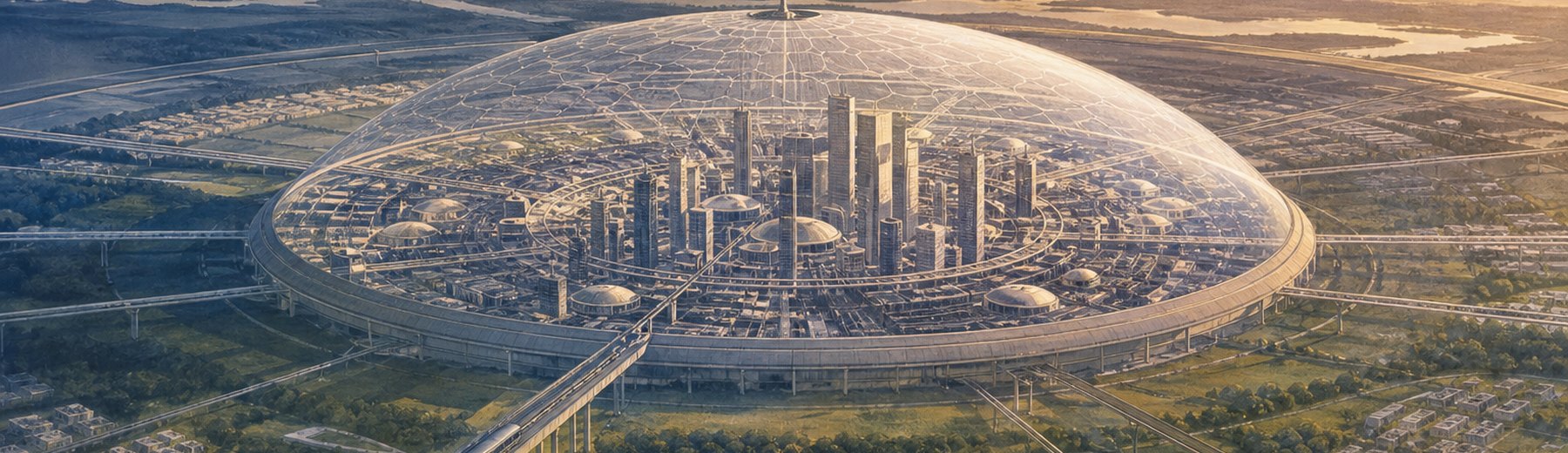
The plan was radial and layered. A high-density core. Ringed housing. A greenbelt. Low-density residential beyond that. Monorails would connect the city to the outside world. PeopleMovers (and related WEDway concepts) would carry residents from home to work and shopping without dumping everyone into a parking lot first. Cars, if anyone still kept one, were for occasional weekend trips, stored at the edge rather than woven through every block.
He had already tested pieces of the idea at Disneyland. The monorail arrived in 1959. The PeopleMover followed in 1967. EPCOT was supposed to take those toys and make them infrastructure.
I wish that part would come back hardest. Not because Charleston needs a dome. Because every master plan I tour still organizes life around the driveway, then adds a trail as an amenity. Walt wanted the reverse: transit and walking as the default, cars as the exception.
A climate-controlled downtown
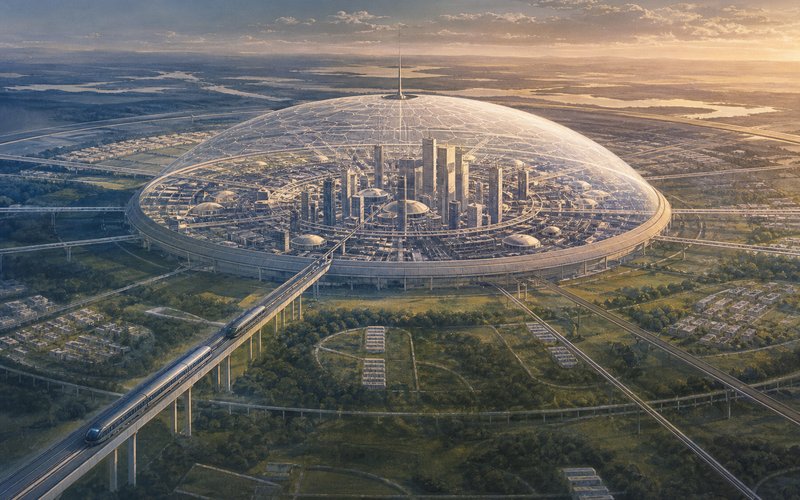
At the center sat a climate-controlled glass dome over the commercial core. Comfort was the sales pitch. Control was the point. Weatherproof living against Florida heat and storms, and a downtown sealed from outside chaos.
The centerpiece was a hotel and convention complex often described around thirty stories, with international shops and restaurants around it. Those ideas later resurfaced as World Showcase. On the dome's roof: recreation decks, tennis, pools, terraces. Walt reportedly told his team that was where he and Lilly would sit when it was finished. The city was never built. The park borrowed the shopping-and-nations energy and left the residential engine on the cutting-room floor.
Everyone worked. Nobody retired.
EPCOT was designed as an ongoing experiment. Experiments need participants. Every adult was expected to work in the park, in corporate research labs, or in the service jobs that kept the convention center, transit hub, and airport concepts running.
If you could not work, you could not stay. Retirement, in Walt's framing, meant stagnation. Guaranteed jobs sounded utopian. Absolute company control sat underneath. No voter-led protests. No city council pushback. Residents were not citizens so much as the workforce that kept the prototype moving. Housing was to be rented, not owned, so Disney could keep rearranging people and floor plans as the experiment required.
Walt called EPCOT a "living blueprint of the future." A blueprint does not need retirees. It needs builders. I want the blueprint energy back. I do not want the part where you lose the right to grow old in your own town.
Homes as laboratories
Houses were modular test sites, not forever customization projects. Disney had already tried the idea with the Monsanto House of the Future at Disneyland in the 1950s. EPCOT took it further: rooms that could sprout outward, kitchens ripped out and replaced, corporate appliances installed whether you shopped for them or not.
GE, Westinghouse, and others saw everyday families as live test groups. In Walt's words, EPCOT would "always be in a state of becoming." People were not allowed to retire. Houses were not allowed to grow old.
The Carousel of Progress (born as GE's Progressland at the 1964 New York World's Fair, still running at Walt Disney World) is the clearest surviving artifact of that optimism. It remains my favorite Disney attraction: a time capsule of the belief that innovation could remake ordinary life. Every time I ride it, I feel the EPCOT city trying to speak through a theater that was never meant to be the whole story.
Buying Florida land, Disney-style
Walt quietly assembled about 27,000 acres of Central Florida swamp and cattle land (often cited around 27,400) through dummy corporations. One was named M.T. Lott Real Estate. Say it aloud. Others used layered holding names so sellers would not price the land like a Disney announcement.
By the time reporters caught on, he held land roughly twice the size of Manhattan for about five million dollars. Then he needed autonomy. Local zoning would strangle the vision. After a pitch film, the Florida legislature created the Reedy Creek Improvement District in 1967, giving Disney near-county authority over fire, utilities, waste, roads, even airports. A private government as the backbone of a prototype city.
That land-and-governance move is why EPCOT could have been attempted at all. It is also why the story still unsettles people who care about local control. Walt wanted a laboratory with its own utilities. Florida gave him a district. The residential city still did not arrive.
What got built instead
The EPCOT film, shot in October 1966, was Walt's last major presentation. Two months later, on December 15, 1966, he died. Roy carried the Florida project forward, but the residential city collapsed without Walt's personal drive and political will. Magic Kingdom opened in 1971. EPCOT Center opened on October 1, 1982 as a theme park: half Future World, half permanent World's Fair. Not the city on the model.
A portion of the Progress City scale model still spins on the Tomorrowland PeopleMover. It remains the closest public glimpse of the dream. I have watched that model more carefully than some people watch the fireworks. It is a tiny city that never got a zip code, and it still feels more ambitious than half the "innovative communities" in today's marketing decks.
Celebration, Cotino, and the almosts
The curated-community idea never fully died. It just got safer.
Celebration, Florida (announced 1991, first residents 1996) was Disney's first real-world town: porches, picket fences, famous architects, strict design guidelines and HOAs. Charm with rules. Nostalgic more than futuristic. Roughly 11,000 people still live there. It proved Disney could build a town people would buy into. It did not prove Walt's laboratory city.
Storyliving by Disney / Cotino in Rancho Mirage, California, is the next chapter: roughly 618 acres, about 1,900 homes, a huge lagoon, club membership, Imagineering-flavored public space. Ownership this time, not EPCOT's rental-only labs, but still a brand-managed lifestyle with HOA dues attached.
I respect the craft. I still wish for the harder version: transit-first living, continuous invention, and a downtown that behaves like a research campus instead of a lifestyle brochure. Celebration and Cotino are cousins of EPCOT. They are not the return of EPCOT.
The Charleston echo
If you buy in a Charleston-area master plan (Nexton, Cane Bay, Carnes, Daniel Island, Point Hope), you already know the modern version of the argument: amenity packages, design covenants, layered associations, and a developer's story about how life should feel. Walt did not invent HOAs. He did accelerate the American appetite for planned living as a product.
What I want from that echo is selective. Keep the ambition to design whole places, not just lots. Keep the idea that daily life can be engineered for less car dependence. Leave behind the fantasy that a corporation should own your right to age in place. Charleston buyers already negotiate that tension every time they read a covenant package. EPCOT is the origin myth for the tension.
Why I still wish EPCOT would come back
Would I have lived in Walt's EPCOT? Mostly yes. Monorails, overnight appliance upgrades, and a downtown that treated progress as a civic duty sound fascinating. The no-retirement clause is where I draw the line. The no-ownership clause is where I negotiate hard.
When I say I wish EPCOT would come back, I do not mean I want a company town with a dome and a rule against grandparents. I mean I want America to try again at the brave parts:
- Build places where cars are optional for ordinary days.
- Treat housing, transit, utilities, and work as one design problem.
- Let a community stay in a state of becoming without pretending a theme park ticket is the same thing as a future.
- Keep residents as citizens, not as unpaid product testers with no exit.
That is the EPCOT I want back. Not the golf ball alone. The unfinished city on the model board.
Why this story matters to buyers
EPCOT still shapes how we talk about real estate: who controls the rules, what you actually own, how much of daily life is curated by a corporation or a master association, and whether a community is allowed to age in place or must stay in a permanent state of becoming.
Even in his last days, Walt used hospital ceiling tiles as a city map, each tile a square mile of EPCOT. He was planning until the end. I keep that image because it is the opposite of cynical real estate. It is a reminder that someone once believed a city could be invented on purpose, for people who would actually live there.
I still believe that. I still wish the city would come back. Until it does, I will keep helping buyers read the master plans we actually have, and I will keep telling this story so the golf ball is never the whole answer.
Original Substack essay: The City Walt Disney Never Built. Related reading: Almost 20 years later, Johns Island is not what was planned and HOA fees in Charleston master-planned communities.