A wave of new parks, flood-control green space, and transit is coming to the Charleston region. Here is what is actually being built, and what it means if you own a home here or you are trying to buy one.
When people ask me what makes a Charleston neighborhood a good bet, they expect me to talk about schools, comps, and commute times. I do. But there is a quieter signal, the one that shows up in your equity years later, and it is this: whether the public money is flowing toward your block or away from it.
Right now a surprising amount of it is flowing toward parks, flood control, and getting around. The region is spending real dollars on green space and drainage at the same time, which for a coastal city is close to the whole ballgame. Here is what is on the board.
A 94-acre park is coming to the East County
Charleston County Parks recently acquired nearly 94 acres just south of Awendaw, off Highway 17. The property is freshwater ponds, hardwood forest, and wetlands, and it backs up against the Francis Marion National Forest. Public input meetings are expected later this year, so the final design of the future East County recreation site is still an open question.
Why it matters: the East County stretch of the region, Awendaw, McClellanville, and the rural run up Highway 17, has almost no built public recreation. A regional park there does two things at once. It hands that corridor a genuine amenity, and it locks a permanent green buffer against the national forest, which quietly protects the very character that buyers up there are paying for. Land next to a committed public park tends to hold its value better than land next to whatever might get built.
The quieter story here. A park is only as good as the land around it, and the reason this stretch stays wild is decades of conservation work next door, much of it by Lowcountry Land Trust. They are the people I point buyers and owners toward when they care about what does not get built. Here is why I love their work, and how you can support it.

A $38 million rebuild in West Ashley
The City of Charleston is launching a $38 million rebuild of the W.L. Stephens Recreation Center in West Ashley. The plan replaces an aging 1970s aquatic facility with a 25-meter indoor pool, a separate therapy pool, fitness rooms, and an inclusive playground.
Why it matters: West Ashley is where a lot of my first-time and move-up buyers land, because the price per square foot still makes sense inside the city limits. A modern rec center with a year-round indoor pool is exactly the kind of daily-life amenity that makes a neighborhood sticky, the sort of thing families actually use every week. It is also an inclusive-design build, with a therapy pool and an accessible playground, which matters for families with a wider range of needs than the old 1970s facility was ever designed for. And it does not stand alone. It sits inside Plan West Ashley, the city’s adopted vision for reworking this side of the river’s streets, parks, and tired commercial corridors, which tells you the rec center is a first move, not a last one.
The city is fighting the water with parks
Here is the part that is pure Charleston. The city is taking flood-prone individual lots and turning them into neighborhood pocket parks, small pieces of ground that hold stormwater instead of a house that keeps flooding. That work sits alongside bigger nature-based projects: the recently opened Bridgepoint Ecological Park in the Church Creek basin, and the Dale T. Morris park on Johns Island, both designed to catch and slow the water before it reaches the homes around them. None of this is improvised. It traces back to the city’s Flooding and Sea Level Rise Strategy, the plan that made green, water-absorbing ground an official part of how Charleston fights the water.
Why it matters: if you have read my flood-zone guide, you know I do not sugarcoat water in this market. It drives your insurance, your resale, and your peace of mind every September. A city that is buying up the worst-flooding lots and converting them to drainage is a city trying to take pressure off the houses next door. It is not a force field, and it will not move a home out of a flood zone on paper. But real nature-based flood mitigation on the next block is a genuine, checkable positive when you are weighing two homes in the same basin.
The Lowline: a linear park downtown
Downtown, the City and the nonprofit Friends of the Lowline are moving into phase one of the Lowline, a linear park planned along an old rail corridor near the Septima Clark Expressway. Phase one is the unglamorous, important part: cleaning up contaminated soil, restoring ecological landscaping, and reconnecting neighborhoods that were cut apart when the expressway went in.
Why it matters: picture what the High Line did for the west side of Manhattan, scaled down to Charleston and rebuilt on Lowcountry ground. Linear parks reliably lift the value of the blocks they run through. This one also does something no chart can capture. It stitches back together upper-peninsula neighborhoods that a highway split decades ago, which is its own kind of return.
Union Pier: 65 acres of waterfront in play
On the downtown waterfront, the peninsula’s last large underdeveloped harbor site is moving from cruise terminal to redevelopment. Ben Navarro’s Marti Holdings is buying the roughly 65-acre Union Pier from the S.C. State Ports Authority for about $250 million, with closing expected in 2027. The last cruise ship sailed June 30, 2026. City officials have also worked on a Tax Increment Financing district so future property-tax growth can fund public waterfront space, parks, and surrounding infrastructure.
The near-term signal is on the edges. Post and Courier reporting in August 2026: Navarro-linked companies paid about $3.8 million in July for 2, 8, 10, and 12 N. Market Street — currently a construction trailer and parking between East Bay and Concord — to create a pedestrian “gateway” from City Market toward the harbor. That stack also includes last year’s $11.5 million Carroll Building purchase, now framed as a gift for a College of Charleston School of Business, and The Cooper hotel, which recently opened just south of Market. Specific N. Market plans have not been filed yet; the pier itself is described as incremental buildout from the edges. Track entitlements and public-realm details on Charleston Pulse.
Why it matters: Union Pier is one of the largest pieces of downtown waterfront to come available in a generation. How much of it stays public, and how much becomes accessible park versus private development, is the kind of decision that shapes the peninsula for the next fifty years. If you own anything nearby, this is the file to watch.
Getting across the Ashley, and around the region
Two connectivity moves are worth knowing about. Regional planners approved additional funding for the Ashley River Crossing, a dedicated bike and pedestrian bridge that will finally link downtown to West Ashley without sharing a lane with traffic. Separately, land has been acquired for a Lowcountry Rapid Transit park-and-ride hub near Exchange Park, part of the region's planned bus rapid transit line.
Why it matters: traffic is the number one complaint I hear from people moving here. A safe, separated bike-and-walk connection between West Ashley and downtown changes the daily math for anyone on that side of the river, and rapid-transit park-and-rides tend to lift the value of the neighborhoods that feed them. Infrastructure that shortens your commute is infrastructure that shows up in your listing price later.
None of these projects close on a house for you. But when a coastal city spends at the same time on parks, drainage, and getting around, it is telling you where it expects people to want to live. That is worth reading before you sign anything.
What this means if you are buying or selling here
I am not telling you to buy a house because a park is coming. Announced is not the same as built, and Lowcountry timelines slip. But public investment is one of the most underrated signals in real estate, precisely because it is slow, expensive, and hard to reverse. A city does not spend $38 million on a rec center, or years cleaning soil for a linear park, in a place it expects to empty out.
When I walk a buyer through two similar homes, this is part of what I am checking quietly in the background. Is the public money flowing toward this block or away from it? Is the flooding getting worse, or is someone building drainage next door? Is this corner about to get more walkable or more congested? You feel those answers years later, in your resale and your quality of life, long after you have forgotten the paint color.
If you want to know how any of this lands on a specific street or a specific listing, that is exactly the kind of thing I dig into before my clients write an offer. Tell me what you are looking at and I will tell you what I would want to know about it.
Charleston has always been a city that shapes its own ground. This is simply the current chapter. If you are trying to figure out where in it to put down roots, I would love to help you read the map.
Go to the source
Read the plans yourself
I would rather you not take my word for it. Almost everything above traces back to public planning documents anyone can open and read. If you want to see for yourself where the region is pointed, these are the four worth bookmarking.
- Charleston City Plan. The city’s current comprehensive plan, adopted in 2021. The ten-year blueprint the rest of these hang off of.
- Flooding & Sea Level Rise Strategy. How Charleston plans to live with water. The thinking behind the drainage projects and the flood-lot pocket parks above.
- Plan West Ashley. The vision steering West Ashley’s streets, parks, and aging commercial corridors, the world that new rec center sits inside.
- Rethink Folly Road. The complete-streets plan for one of James Island’s busiest corridors, and a template for how the region wants its roads to work.
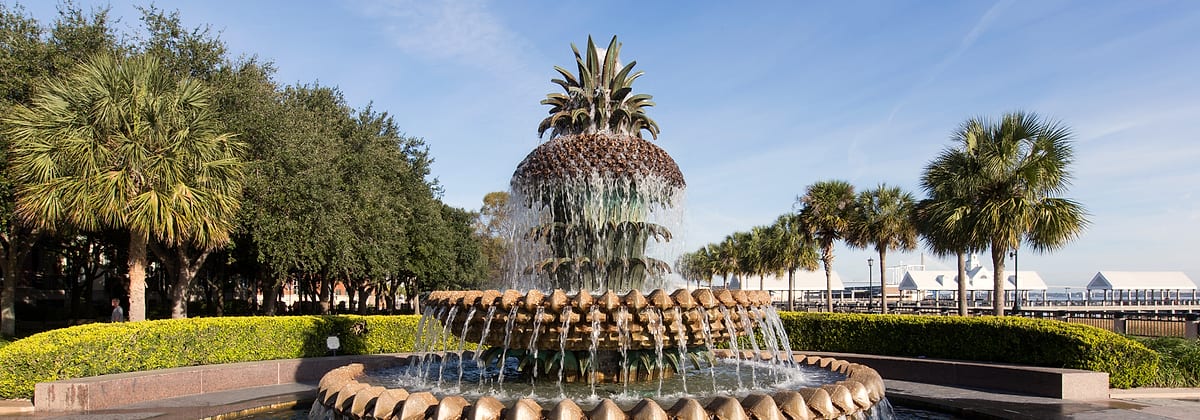
Project details are drawn from public announcements and planning materials from the City of Charleston, the Charleston County Park and Recreation Commission, Friends of the Lowline, and regional planning agencies, plus contemporaneous reporting (including The Post and Courier on Union Pier gateway purchases), and were accurate to the best of my knowledge at the time of writing. Public projects change in scope, budget, and timeline; verify current status before relying on any detail here. Banner and share images: the Pineapple Fountain at Charleston's Waterfront Park, photo by Bohao Zhao via Wikimedia Commons (CC BY 3.0, cropped; the share image adds the post title overlay). This post is for general information only and does not constitute legal, financial, tax, or investment advice. Jennifer Dane is a licensed REALTOR® in South Carolina with eXp Realty LLC. Equal Housing Opportunity.