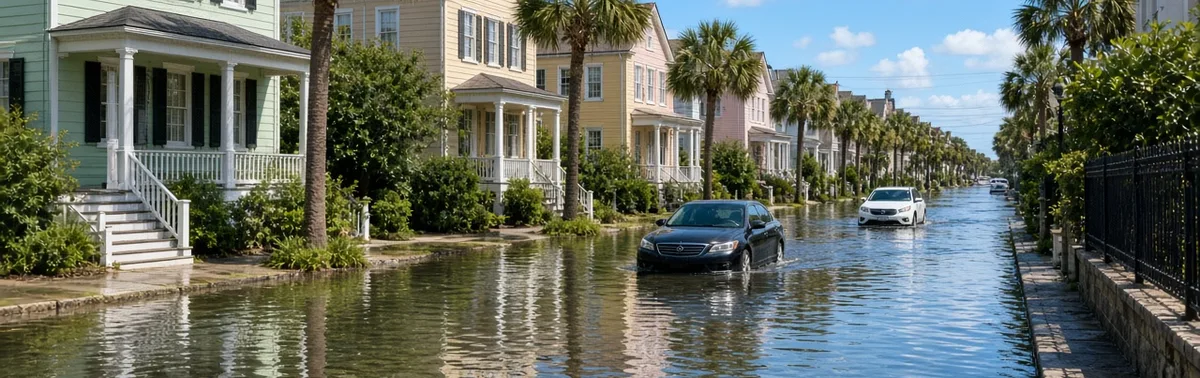
The first time I saw saltwater on a Charleston street under a perfect blue sky, I thought someone’s pipe had broken. Locals just said, “king tide,” and kept walking.
If you are moving here from somewhere inland — or even from another coast that floods only when it storms — this is the Lowcountry lesson that lands after the closing gifts are unpacked. It does not have to rain for the street to fill. The harbor rises on a schedule. Some blocks negotiate with that schedule several times a year. I wish someone had walked me through it before I treated “flood zone” as the only water question that mattered.
In one sentence: A king tide is one of the year’s highest predicted astronomical tides. In Charleston it can push seawater onto low roads, parking lots, and storm drains on a sunny day — especially in fall — and it is predictable enough to plan around if you know where to look.
What a king tide actually is (without the jargon)
King tide is not a FEMA term. It is the everyday name for the highest predicted tides of the year — what scientists call perigean spring tides — when the gravitational pull of the sun and moon lines up and the moon is near its closest approach to Earth. Charleston Harbor normally swings about five to six feet between low and high. During a king tide, water can rise an extra foot or more above a typical high, enough to spill into streets that stay dry most weeks.
The City of Charleston puts it plainly: average high tide here runs about 5.5 feet (MLLW). During a king tide event, highs may reach 7 feet or higher. That gap is the whole story for many peninsula and low marsh-edge streets.
The numbers locals watch
| Threshold (Charleston Harbor, ft MLLW) | Who uses it | What it means on the ground |
|---|---|---|
| 6.5 | NWS Action Stage | Pay attention; impacts possible in flood-prone spots |
| 6.6 | SCDES / MyCoast king-tide alert | Predicted king-tide notification level |
| 7.0 | NWS minor flooding | Nuisance flooding on low roads common |
| 7.5 | NWS moderate flooding | More widespread street impacts |
| 7.6 | NOAA high-tide flooding | Formal HTF threshold for Charleston |
| 8.0 | NWS major flooding | Serious coastal flooding |
Sources: City of Charleston King Tides page; SCDES / MyCoast SC King Tides Initiative; NWS Charleston. Tide height at your street will not match the harbor gauge exactly.
Fall is the season nobody warns you about
Hurricane season gets the headlines. For pure tidal flooding, fall is the busy season on the Lowcountry coast. NWS Charleston notes that fall — especially September and October — leads the year for coastal flooding events at Charleston Harbor, with perigean spring tides often peaking near minor flood stage even without a named storm.
Predicted Charleston Harbor king-tide windows for 2026 (NOAA / SCDES listings used by Kiawah and MyCoast) include:
- May 15–18 · June 14–16 · July 13–14 · August 11–12
- September 29–30
- October 10–11 and October 26–29
- November 24–27
Those dates are astronomical predictions. Onshore wind, low pressure, and rain can push the same tide over the flooding line — or spare you. Always check the week-of forecast.
What I did not know before I moved here
- Sunny-day flooding is not a metaphor. Clear sky, dry windshield, saltwater across the asphalt. The listing photos were taken at low tide for a reason.
- Storm drains can work backwards. When the harbor is high, water can come up through the drains. That is why a “dry” forecast still leaves cars stranded on Lockwood, parts of the Market area, and other low corridors.
- FEMA Zone X is not a king-tide hall pass. The map is about insurance requirements and modeled floodplains. A Zone X street can still take tidal water while an elevated house stays fine. Ask how the block behaves, not only what the panel says. Start with the flood zones guide.
- Your commute has a tide chart. School drop-off and downtown appointments collide with evening or morning highs in fall. Build 20 minutes of buffer on king-tide weeks or learn the bypass routes.
- Parking and garage strategy matter. Street parking on a flooding block is a different risk than a raised garage. Ground-floor storage and HVAC placement matter more than the brochure admits.
- Insurance and king tides are related but not identical. Flood policies protect the structure from inundation. They do not make the road passable or keep the crawlspace dry by magic. Price the full coastal stack anyway — and quote early so insurance does not kill the deal (why quotes kill deals).
- Neighbors already know. The best diligence is still: “Where does the water stop on this street in October?” Plus public tools below.
Buyer script I use: “Show me this house at a predicted high tide week — or walk me through last fall’s photos and road closures for this block.” If the listing side cannot answer, that is your answer.
Tools that make you look like a local on week one
- TIDEeye — City of Charleston live tides, road conditions, and king-tide context (gis.charleston-sc.gov/tideeye).
- Road closures map — regional traffic impacts when water takes a lane (City flooding tools hub).
- MyCoast SC King Tides — predicted dates plus community photos that show how high the water really got (mycoast.org/sc/king-tides).
- Check This Address — our on-site first pass for flood notes and tax traps before you tour (buycharlestonsc.com/check-this-address).
How this changes the house hunt
- Peninsula / downtown: Assume tidal nuisance flooding is a lifestyle factor on low streets. Budget time and parking, not just insurance.
- James Island, West Ashley river edges, marsh-front Mount Pleasant: Same question, different gauge. Edge parcels and long driveways need a high-tide story.
- Summerville / inland Berkeley: King tides are not your daily drama — river and rain flooding still can be. Do not skip flood diligence just because you left the harbor.
- Showing strategy: When a fall king-tide window is on the calendar, try to tour problem streets near high tide. Reality beats a noon listing appointment.
Bottom line
Moving to Charleston without understanding king tides is like moving here without understanding humidity — technically possible, emotionally rude. The water is on a clock. Fall is busy. Sunny skies do not mean dry streets. Learn TIDEeye, ask the block-level question, price flood insurance like an adult, and you will love the Lowcountry with your eyes open. That is the welcome packet I wish I had.